




Classification of highway marking paint
【Summary Description】 Introduction to the classification of highway marking paint: two-component marking paint. The base material and curing agent used in highway marking paint are mixed in proportion and dried through a chemical cross-linking reaction, forming a hard paint film that adheres well to the ground, glass beads, and reflective beads for rainy nights. It has advantages such as quick drying, wear resistance, water resistance, acid and alkali resistance, and good weather resistance. It is suitable for various climatic zones.
Highway marking paintClassification introduction:
Two-component marking paint. The base material and curing agent used in highway marking paint are mixed in proportion and dried through a chemical cross-linking reaction, forming a hard paint film that adheres well to the ground, glass beads, and reflective beads for rainy nights. It has advantages such as quick drying, wear resistance, water resistance, acid and alkali resistance, and good weather resistance. It is suitable for various climatic zones.
Hot-melt reflective road marking paint. It dries quickly, has a thick film, long service life, and good reflective durability, currently dominating the market.

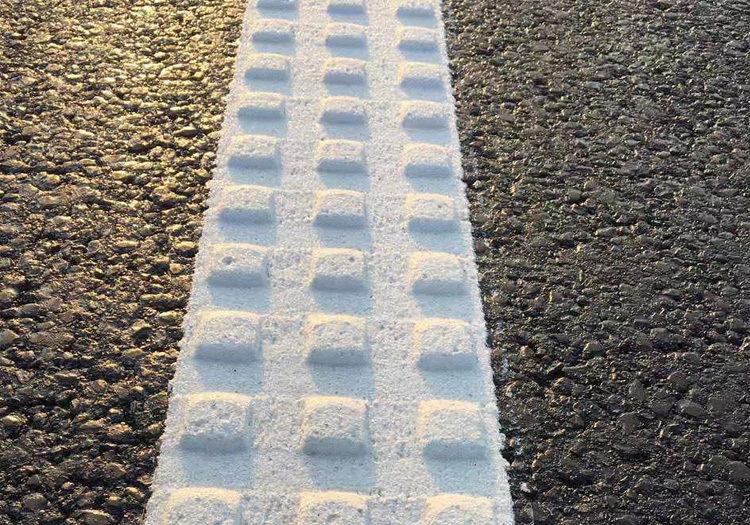
Prominent vibration reflective marking paint. Developed based on hot-melt coatings, it can be used for deceleration, vibration, warning, rain lines, etc. It comes in ribbed, dot, and rain groove types. Currently, deceleration lines and edge lines on highways have been widely used.
Room temperature solvent-based road marking paint. Traditional marking paint dries slowly, has a short service life, and is low-cost, and is still widely used on urban roads and general roads in our country. Highway marking paint is widely used in road marking construction. Its obvious advantages are short construction time, high wear resistance, and low cost. Regardless of the type of road marking paint chosen, there are strict quality requirements, such as being able to withstand sun, rain, and the impact and friction of passing vehicles. Therefore, current traffic has strict requirements for the performance and quality of road markings. The drying time must be short, operations should be quite simple, and traffic issues should be minimized. Additionally, it must have strong reflective ability or bright colors, and consider comprehensive performance in terms of slip resistance and wear resistance.
With the continuous progress of society and the improvement of people's living standards, cars are becoming more and more popular, and people's traffic awareness and professional ethics are also continuously improving. This has led to more frequent and widespread use of road markings and parking space markings. For example, nowadays, various hotel entrances, access control entrances, or garage entrances also widely use road markings and parking space markings. Currently, the market generally has hot-melt markings and cold paint markings. When using road marking paint, fully mix the product and filter it in the bucket to avoid collisions, rain, and sun exposure. When using, do not mix other coatings with this coating.
When constructing highway marking paint, pay attention to ventilation, especially ensuring that the primer is dry after application to avoid affecting the coating quality. Unused paint should be stored in a sealed container to prevent skinning. The main function of highway marking paint is to implement traffic separation, guiding different types and speeds of vehicles along designated routes through road markings, aiming to improve road transport capacity and reduce traffic accidents. It also guides drivers to predict road conditions through traffic markings.
Want to know moreReflective hot-melt line marking paint, highway line marking paint, hot-melt paintcontent, you can follow us.
Related News


Convenient Navigation
Contact Us
Address: Kechuang Industry,Tianyi Village,Dongcong Town, Nansha District, Guangzhou City, Guangdong Province, CHINA
+86 13427557901 Ms Vivian
( Whatsapp/Wechat/Line:008613427557901 Skype:vivian34686 )
online message