



Advantages of hot melt coatings
【Summary Description】 Reflective thermoplastic paint is mainly used for secondary roads and highways. The thickness of the road marking paint made from this coating is (1.5 ~ 2.5) mm, and reflective glass beads are mixed into the paint, which are sprinkled on the surface during the marking construction. This type of marking has good reflective performance at night and a long service life. Depending on the traffic volume of the road construction and the quality of the paint itself, it can generally last (2 ~ 3) years. The application of thermoplastic paint requires special heating equipment. When repainting old markings, the thicker old coating should be removed before application. Precautions for using thermoplastic marking paint. Use a hand cart.
ReflectiveHot Melt CoatingMainly used for secondary roads and above, as well as highways. The thickness of the marking paint made from this coating is (1.5 ~ 2.5) mm, and reflective glass beads are mixed into the coating, which are sprinkled on the surface during the marking construction. This type of marking has good reflective performance at night, a long service life, and generally can last (2 ~ 3) years based on the demand for various road marking coatings due to heavy traffic and the quality of the coating itself. The construction of hot melt coatings requires special heating equipment. When repainting old markings, the thicker old coating should be removed before application. Precautions for using hot melt marking paint: when loading with a hand cart, a filter screen should be used to avoid impurities entering and causing scratches on the marking. The optimal construction temperature is around 180℃, and prolonged heating at 170℃-210℃ and above 3200℃ will cause some components to volatilize, affecting the quality of the paint. If the temperature exceeds 4230℃, the paint will burn and discolor, affecting its quality.

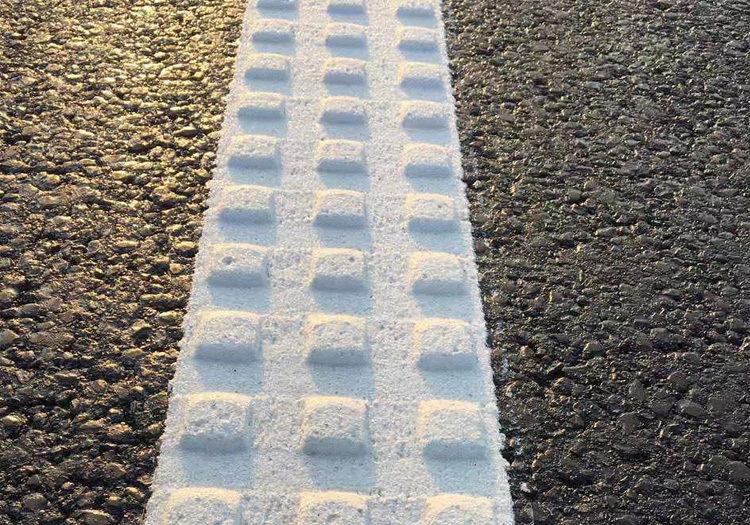
Hot melt coatings are in powder form at room temperature and contain no volatile solvents. Heating melts it, and then it is coated on the ground using specialized equipment, solidifying into a film through physical condensation. Its application has the following four advantages: the film has quick-drying properties. It can dry and allow traffic within 1-3 minutes after painting, and construction can even be done without blocking traffic. Good usage effect. The film line of hot melt coatings is complete and clear, with sharp edges, high brightness, and strong three-dimensionality. Excellent wear resistance. The coating film is durable, and the service life of the marking can reach 2 years. Nighttime reflectivity. Due to the addition of glass reflective materials in the hot melt coating, glass beads can be scattered on the surface during construction, resulting in better reflective effects, reducing traffic accidents, and meeting the requirements of modern traffic facilities.
For hot melt road coatings, its fluidity is a very important technical index during the construction process. When changing the fluidity of hot melt coatings, it is generally achieved by increasing the resin content or using various processing additives, which can make the coating difficult to dry to a certain extent, while also softening the film, making it easy to get dirty. Additionally, a more important point is that increasing the content of additives or resins in the coating will also increase the manufacturing cost of the coating.
Due to the characteristics of super-fast drying, durability, strong wear resistance, and nighttime reflectivity in the construction of hot melt coatings, their application range and uses are expanding year by year. With the rapid environmental protection of modern construction and the high requirements for wear resistance, weather resistance, and durability of markings, low-cost hot melt marking coatings have become the choice for road marking coatings in our country. An important performance of good hot melt coatings is their brightness and fluidity during the construction process. Unlike other road markings, it does not contain volatile solvent components. During construction, the powder coating is heated and melted, then coated on the ground with specialized equipment, and solidifies into bright markings. Therefore, its film-forming mechanism does not rely on the evaporation of solvents like ordinary coatings, but rather on physical condensation and curing. It is suitable for urban roads and major highways with heavy traffic, and is also used as reflective markings on highways in our country and some other countries.
Want to know moreHighway marking coatings, reflective hot melt line marking coatings, road marking coatingscontent can be followed by us.
Related News


Convenient Navigation
Contact Us
Address: Kechuang Industry,Tianyi Village,Dongcong Town, Nansha District, Guangzhou City, Guangdong Province, CHINA
+86 13427557901 Ms Vivian
( Whatsapp/Wechat/Line:008613427557901 Skype:vivian34686 )
online message