
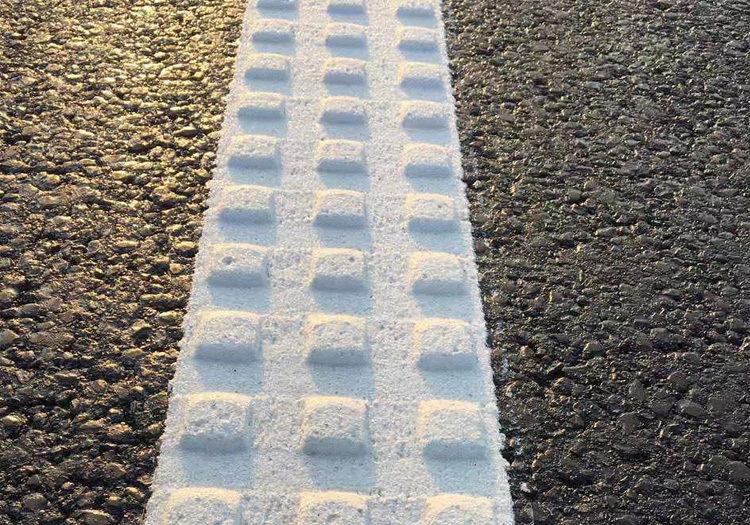




Characteristics and Scope of Hot Melt Coatings
【Summary Description】 Introduction to the characteristics and application range of hot melt coatings: Fast drying. After marking with hot melt coatings and applying glass beads, it should dry quickly within a short time (less than 5 minutes) regardless of the weather. Generally, thermoplastic road reflective coatings have good fast-drying (curing) performance, with rapid curing in cold seasons and slow curing in warm seasons. When the coating cures quickly, it may warp due to shrinkage, resulting in poor surface flow parallelism and poor quality of glass bead fixation. When the coating cures slowly, not only do the scattered glass beads sink into the coating, reducing reflectivity, but it also delays the opening time for traffic, reducing traffic capacity. Therefore, it is usually necessary to lower the temperature of the coating in a molten state to.
Hot melt coatingIntroduction to its characteristics and application range:
Quick drying. After marking with hot melt coating and applying glass beads, it should dry quickly in a short time (less than 5 minutes) regardless of the weather. Generally, thermoplastic road reflective coatings have good quick-drying (curing) performance, with rapid curing in cold seasons and slow curing in warm seasons. When the coating cures quickly, it may warp due to shrinkage, resulting in poor surface flow parallelism and poor quality of glass bead fixation. When the coating cures slowly, not only do the scattered glass beads sink into the coating, reducing reflective capability, but it also delays the opening time for traffic, reducing traffic capacity. Therefore, it is usually necessary to lower the temperature of the coating in a molten state to shorten the curing time.

Adhesion and adhesion mechanism. There must be strong adhesion between the marking coating and the pavement, and it should not peel off or be damaged. Good adhesion to the pavement ensures that the coating does not quickly peel off due to vehicle rolling, slipping, or braking; the pavement should not crack, bend, or peel off due to seasonal temperature changes. The thermoplastic road marking coating is heated to 180°C-220°C (the temperature is chosen based on the type and formulation of petroleum resin used in the coating) to melt the thermoplastic resin in the coating, allowing the coating to be in a molten flow state, which is then applied to the pavement using a specialized marking machine, while glass beads are spread and cured at room temperature. When coated on a cement pavement, the high-temperature molten coating mechanically bonds with the cement pavement, resulting in poor adhesion. To enhance the adhesion between the pavement and the coating, it is necessary to apply a road marking primer in advance.
Visibility. Whether during the day or at night, hot melt coatings should be bright, uniform, and clear, with sufficient visual recognition distance. Daytime visibility depends on the quality of the pigments, which is relatively easy to address. Nighttime visibility, or reflectivity, primarily depends on the quality of glass bead distribution. The distribution of glass beads should be uniform. If the amount is moderate, both excessive and insufficient amounts can affect the reflective effect of the markings. Secondly, temperature control during the marking construction process is crucial. If the temperature is too high, the fluidity of the coating will be stronger, meaning lower dilution and higher penetration, causing glass beads to settle faster, even sinking into the molten coating, resulting in poorer reflective effects. If the temperature is too low, the glass beads will not adhere well, only ensuring immediate reflective effects after construction, with poor long-term reflective effects. Experience shows that the best reflective effect occurs when half the diameter of the glass beads is embedded in the coating. However, achieving this is not easy. Therefore, the glass beads are affected by the coating temperature, thickness, and climatic conditions, and the spreading time should be strictly controlled during construction. Attention should be paid to the equipment for distributing glass beads, as well as the influence of wind force and wind direction (natural wind and wind caused by passing vehicles next to the marking vehicle) on the distribution of glass beads, to avoid bead accumulation. Excessive spreading can worsen the daytime tone, causing unevenness and making it easy for dust to stick, reducing recognizability. The granularity, roundness, and quality of glass beads are also important factors affecting visibility.
Durability. The forward movement of vehicles entirely depends on the friction between the wheels and the ground, which places high demands on the markings. In our country, road conditions are complex, with damaged pavements being hard, and metal wheels rolling over, which raises the requirements for the wear resistance of road markings.
Weather resistance. Thermoplastic coatings should have excellent weather resistance. Considering the diverse regions, with dry in the east and west, hot in the south and cold in the north, and many pavements, the formulation of the coating's raw materials can be adjusted to adapt to different climatic conditions, allowing for use in different seasons. Durability should meet the expected service life of the markings. If road markings are planned to be repainted every two years, the best marking coating should mostly peel off around the two-year mark, or the pavement base can be easily cleaned to avoid old lines affecting the guidance of new markings on traffic flow, or consuming a lot of labor hours for cleaning.
Based on years of construction experience and experimental results, the application range of thermoplastic coatings is summarized as follows: suitable for center lines, lane boundary lines, edge lines, and guide lines with high wheel rolling; pedestrian crossings, intersections, parking lots, and unlit roads at night; in terms of adhesion, asphalt pavements perform best, followed by cement pavements. They are not suitable for sandy pavements, brick pavements, temporary pavements, and pavements that will be expanded within six months.
Want to know moreHighway marking coatings, road marking coatings, reflective hot melt line marking coatingscontent, you can follow us.
Related News


Convenient Navigation
Contact Us
Address: Kechuang Industry,Tianyi Village,Dongcong Town, Nansha District, Guangzhou City, Guangdong Province, CHINA
+86 13427557901 Ms Vivian
( Whatsapp/Wechat/Line:008613427557901 Skype:vivian34686 )
online message