
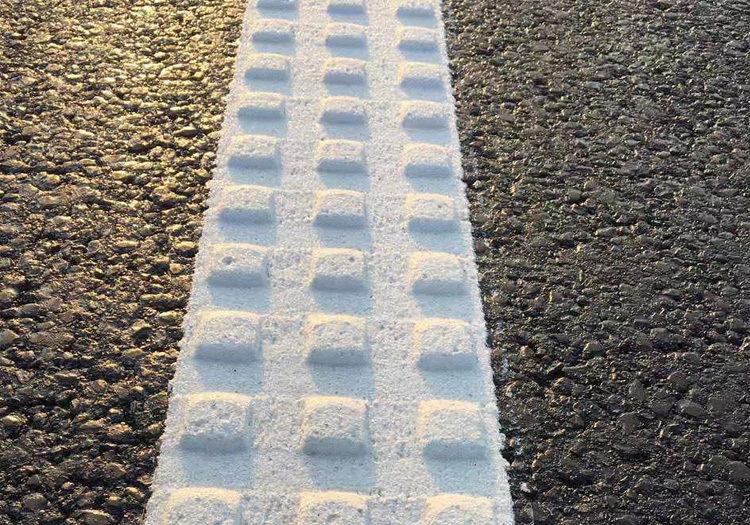




This model of paint is mainly suitable for highways with high design requirements. The viscosity is moderate and fluctuates little at temperatures between 180℃ and 220℃, ensuring no sedimentation during long-term insulation, allowing the internal mixed beads to be evenly distributed in the molten paint. The addition of high sphericity glass beads results in a higher retroreflective coefficient after wear, making the markings brighter at night. The addition of new-type additives can accelerate the melting of the paint, improve work efficiency, and save gas. It has good fluidity, and during rapid application, the line-drawing bucket still maintains smooth discharge.
This model of paint is mainly suitable for highways with high design requirements. The viscosity is moderate and fluctuates little at temperatures between 180℃ and 220℃, ensuring no sedimentation during long-term insulation, allowing the internal mixed beads to be evenly distributed in the molten paint. The addition of high sphericity glass beads results in a higher retroreflective coefficient after wear, making the markings brighter at night. The addition of new-type additives can accelerate the melting of the paint, improve work efficiency, and save gas. It has good fluidity, and during rapid application, the line-drawing bucket still maintains smooth discharge.
Mainly used in cement and asphalt pavements, designed for the usage needs of ordinary roads, with high cost performance.
For surfaces that are relatively dense and have been treated with diamond sand epoxy or curing agents, it features fast drying speed, moderate viscosity, and accelerates construction progress.


Convenient Navigation
Contact Us
Address: Kechuang Industry,Tianyi Village,Dongcong Town, Nansha District, Guangzhou City, Guangdong Province, CHINA
+86 13427557901 Ms Vivian
( Whatsapp/Wechat/Line:008613427557901 Skype:vivian34686 )
online message