


The formula and function of thermoplastic road marking paint.
【Summary Description】 Currently, the road marking paints used in our country are divided into three types: thermoplastic, water-based, and cold solvent-based. Traffic safety management departments use road markings to enhance traffic safety management, reduce accidents, and beautify urban roads, while eye-catching road markings depend on high-performance marking paints. With the modern construction's emphasis on environmental protection and the high demands for wear resistance, slip resistance, weather resistance, and durability of markings, low-cost thermoplastic marking paints have become the preferred choice for road marking paints in our country.
Formula and Function of Thermoplastic Road Marking Paint
1. Petroleum Resin: The resin content accounts for 11%-15%, which will be adjusted according to different models to achieve the most ideal performance and adhesion, as well as aging resistance.
2. Calcium Carbonate Filler: The proportion is 80%-82%. Our company uses first-grade calcium carbonate ore from Lianzhou processed into powder. Its characteristics are high purity, white color, and good wear resistance, resulting in a more durable reflective effect for the markings.
3. Polyethylene Wax: Content 1%-1.5%, using high-quality polyethylene wax with a high softening point. It has strong pollution resistance and fast drying characteristics. The high-quality polyethylene wax selected by our company can make the paint denser, larger in volume, and have a high coating rate, which is also one of our major features.
4. Pigments: Content 1%-6%, different types and quantities of pigments are added according to different needs, giving the paint various colors and reflective properties. All pigments are top-grade encapsulated pigments, with reasonable ratios and good weather resistance. They do not change color after long-term exposure.
5. Plasticizers: Content 1%-1.5%, using environmentally friendly plasticizers that meet the demands of the times and can improve the toughness of the paint and its compressive strength in high-temperature environments.
6. Additives: Content 0.1%-0.5%, using scientific formulas and unique new additives, employing multiple mechanisms to maintain moderate viscosity of the paint in a molten state, achieving a non-sediment effect. This makes it very convenient for construction painting.
Thermoplastic road marking paint utilizes the thermoplasticity of synthetic resin, allowing the thermoplastic paint to dry quickly, and the thermoplasticity of synthetic resin ensures a strong bond between the markings and the road surface. Thermoplastic reflective road marking paint generally consists of thermoplastic resin, pigment fillers, reflective materials, and other additives. Thermoplastic paint has advantages such as good adhesion, long wear life, strong nighttime reflectivity, quick drying during construction, good weather/water resistance, low cost, affordable price, and being environmentally friendly.
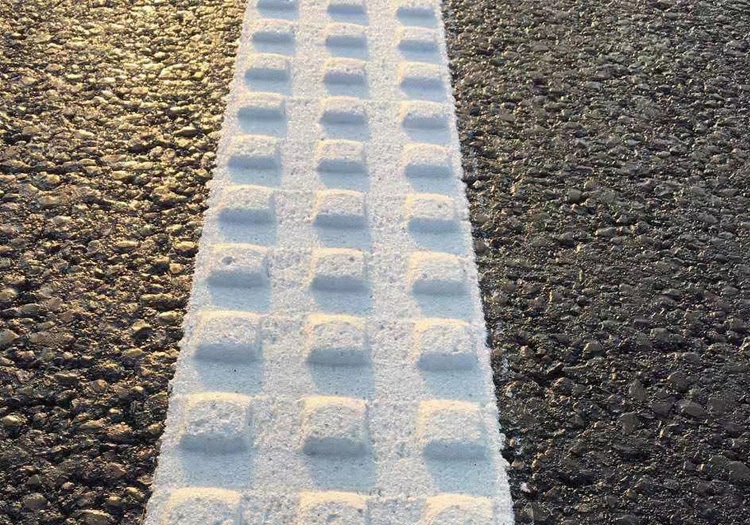
Thermoplastic paint is in powder form at room temperature. There are no solvent volatile components in the ingredients. Heating during construction melts it, and then it is applied to the ground using specialized equipment, relying on physical condensation to solidify into a film. The thickness of the marking layer drawn with thermoplastic paint is (1.0~2.5)mm, and reflective glass beads are mixed in the paint, which are sprinkled on the surface during the marking construction. This type of marking has good nighttime reflectivity and a long service life. Based on the estimated demand for various road marking paints in highway construction due to traffic flow, it can generally last 2-3 years.
Thermoplastic marking paint is in solid powder form at room temperature. During construction, the paint is put into a melting kettle, with the temperature controlled between 180℃ and 210℃, melting while stirring. Once it reaches a molten flowing state, it is placed into the insulated melting hopper of the marking machine. The molten paint is then introduced into the marking hopper and kept warm to maintain its molten state. Before marking, a pre-marking machine marks the position, and the primer is applied using a primer machine at the designated coating position according to the design drawing. After the primer is completely dry, the marking paint can be applied. When starting to mark, the marking hopper should be placed on the road surface. Due to a certain gap between the marking hopper and the ground, when the marking machine moves forward, a neat marking line is scraped out by automatic flow. The glass bead dispenser can automatically and evenly sprinkle a layer of reflective glass beads on the marking.
Key Points for Thermoplastic Paint Road Surface Construction:
1. When dissolving the paint, the temperature should be limited to between 180-220, and after dissolving, stir slowly and keep warm for 3-5 minutes before discharging, to fully utilize the functions of thermoplastic road marking paint.
2. It is recommended to construct under conditions above 0 degrees Celsius, ensuring the working surface is clean and dry (for high-temperature construction, please appropriately increase the material temperature).
3. Leave some margin for the primer treatment, and only apply the marking paint after the primer is completely dry.
4. For newly completed cement surfaces, please try to postpone construction for three months or stop after two applications of primer, otherwise, the markings may easily fall off.
5. When constructing on roads with heavy traffic, after applying the primer, please place warning cones to prevent wheel pressure from removing the primer and leaving dust.
If the material temperature is below 180, the petroleum resin cannot stretch sufficiently, affecting the fluidity of the paint, causing fuzziness in the markings during construction, resulting in numbness on the outer side of the markings, or leaving more residue, affecting the appearance of the markings; at the same time, too low a temperature will affect the extension of petroleum resin molecules, weakening the adhesion of the markings to the road surface.
Reasons for slow drying of thermoplastic marking paint after production are as follows:
1. The standard specified environmental temperature is 23 degrees, and the drying time for thermoplastic marking paint at 23 degrees is less than 3 minutes. If the environmental temperature exceeds this, the drying time will correspondingly increase.
2. If the road surface temperature is high, after the marking is completed, due to the high road surface temperature, in summer, the temperature of asphalt road surfaces can exceed 60 degrees. When the temperature of the hot line marking drops to the same temperature as the sidewalk, it will no longer cool down, and the marking will no longer dry. This phenomenon usually occurs during the day (around 11 am to 4 pm), especially severe for double yellow lines in the middle of the road, as they receive prolonged sunlight and thus dissipate heat slowly.
3. The density of the marking paint itself is a problem; excessive use of leveling agents and other additives can improve leveling but reduce the cost of the paint, lowering the softening point of the marking paint, causing thermoplastic marking paint to gradually dry and soften.
Add WhatsApp: +8615013220400 or WeChat: 13600092611 to get the latest Price!
Related News


Convenient Navigation
Contact Us
Address: Kechuang Industry,Tianyi Village,Dongcong Town, Nansha District, Guangzhou City, Guangdong Province, CHINA
+86 13427557901 Ms Vivian
( Whatsapp/Wechat/Line:008613427557901 Skype:vivian34686 )
online message